The History of the Peoples of the Eastern Desert
(between the Red Sea and the Nile in Egypt and Sudan)
from Prehistory to the Present
Click here for a report of the meeting
 |
 |
 |
 |
 |
 |
 |
 |
 |
 |
 |
| |
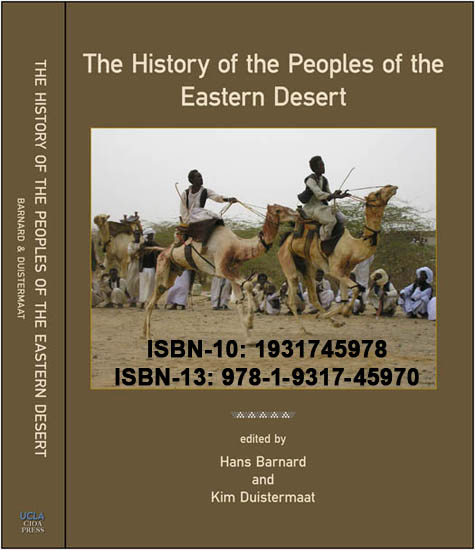 The book resulting from this conference is a letter-sized edited volume containing more than 500 pages richly illustrated with photographs and line drawings, handsomely produced by the Cotsen Institute of Archaeology Press (2012). It comes with a CD-ROM with sound and video fragments as well as the complete bibliography (Chapter 32) in pdf-format.Order your copy here. |
|
Despite environmental degradation and scholarly neglect, the Eastern Desert has its native inhabitants and a history of its own. Sometimes a hint of these can be gleaned from the historical sources, for instance in the case of the Medjay and the Blemmyes, or the archaeological record, such as pan-graves and Eastern Desert Ware but information on the indigenous history, culture and local developments is scarce and incomplete. It is clear that the connection between the dwellers of the desert and the dwellers of the Nile Valley must have been more intricate than indicated by these glimpses into the past as the pastoral nomads in the Eastern Desert have always depended on the farmers in the Nile Valley. The settling of previously mobile hunter-herder-gatherers in the Nile Valley at the end of the Holocene pluvial period, on the other hand, may have been one of the roots of ancient Egyptian civilization.
At some point, the Eastern Desert as a whole should be subjected to a complete revision of Pharaonic, Classical and Arabic sources clarifying the whole mess. [...] We need a chart summing up Pharaonic, Classical and Arabic sources, not only for the Beja Cushitic region, but also the northern Eastern Desert. Rock art studies should be included as well, start with the outdated, but still useful Winkler, etc.
Apart from logistical problems, the study of the Eastern Desert is hampered by biases in the textual sources, by ambiguous ethnographic parallels and by the low archaeological visibility of the remains of the desert dwellers. The vast majority of the historical sources were written by outsiders who never visited the area. They are severely prejudiced towards a settled way of life and express negative attitudes towards mobile groups that exist until today. Ethnographic and ethno-archaeological information is limited and has often been shown to provide only very incomplete parallels between modern and ancient mobile groups in the region. Archaeological evidence on the dwellers of the desert is equally scarce. The emphasis of the research has been on the better visible and easier to interpret remains of the mines, quarries, inscriptions and trade routes of outsiders temporarily settling in the desert. Many studies have been biased towards Pharaonic and Graeco-Roman Egypt, disregarding Napatan, Meroitic and Nubian sources.
The ephemeral traces of the desert dwellers appear difficult to recognize and understand. Indeed, it has only recently been appreciated that sufficient archaeological remains are present to allow firm conclusions on the lifestyle and culture of the dwellers of the Eastern Desert, but until now research was not focused on their discovery. During the past decades the anthropological theory on the relationship between the settled majority and the mobile minority in the Near East has developed from the permanent conflict reflected by the historical sources to the symbiotic relationship deduced from archaeological and ethno-archaeological data. Our current terminology, with fixed categories for mobile and sedentary groups, may not be applicable to the ancient situation in which such groups appear even more intertwined than at present. Unfortunately, these insights come at a time that access into the Eastern Desert (roughly the area between Aqaba, Cairo, Khartoum and Suakin) has become increasingly difficult. A conference organized by the Cotsen Institute and the NVIC, to take place in Cairo (Egypt) 25–27 November 2008, aims to use this intermission of fieldwork in the region to address the problems and possibilities of the study of the dwellers of the Eastern Desert, as well as to provide an overview of the current state of our knowledge.
Theory and methodology in the historical, archaeological and anthropological study of mobile people. The focus is on the Eastern Desert, in all time periods, but contributions need not necessarily be limited to this region. What recent anthropological theories apply to the relation between mobile and sedentary groups in the area? What new techniques and approaches (such as Google Earth, GIS, chemical analyses, geology, climatology, statistics, etc.) should be incorporated in our research?
The history of the peoples of the Eastern Desert. What information do we currently have from textual and archaeological sources regarding eastern Egypt and Sudan? Where do these different data sets agree, where do they differ and how can this be used as a heuristic tool? Can this data be collated into a comprehensive history of the region?
The third and last day of the conference (Thursday 27 November 2008) will be filled with interviews and discussions with representatives of the Ababda, a group of pastoral nomads living in the Eastern Desert, facilitated by a questionnaire and a translator. This will provide a unique opportunity to verify or elucidate matters that emerged during the conference. In the afternoon a summary of the conference will be presented in a public lecture within the framework of the weekly lecture series and the annual Cleveringa Lecture at the NVIC. To enable the discussant to do so, as well as to aid the discussion during the conference, participants will be asked to provide an extensive summary of their presentation well before the start of the conference.
The proceedings of the conference, together with the contributions of invited authors, will be edited as soon as possible after the conference and submitted for publication, after peer-review, with the Cotsen Institute. Publication is planned in a combined paper and on-line format, which allows for the inclusion of large data files, videos, animations, virtual reality reconstructions, etc. UCLA Digital Library will be requested to guarantee the preservation of such digital files.
Those interested to partake in this meeting are invited to convey their intention to participate to the organizers. Please indicate the title and the subject of the intended contribution in a short summary (300–500 words). Presentations are in English and should not exceed 20 minutes, leaving 10 minutes for discussion. The conference will take place 25–27 November 2008 in the Netherlands-Flemish Institute in Cairo (Zamalek) in the presence of a small audience.

1, Sharia Dr. Mahmoud Azmi
11211 Zamalek, Cairo
Arab Republic of Egypt

PO-Box 951510
Los Angeles, CA 90095
United States of America
|
|
|
|